Slidegenius, Inc.

Craft Your Corporate Pitch Decks into a Great Story

“People have forgotten how to tell a story. Stories don’t have a middle or end anymore. They usually have a beginning that never stops beginning.” – Steven Spielberg

Since stories and narratives make up most of our daily interactions, why not treat your pitch as a story?

For communication coach Nick Morgan, there are several ways to structure your presentation, but if you’ve got a story tell, it’s best to go with the Classic Story structure.

Craft your speech with story patterns that your audience recognizes from novels, books, and movies: with a beginning, middle, and an end.

pitchdeck.com Blog Module Three

Get hundreds of pitch deck slides for free.

Sign up for your free account today.

Sign Up now

Begin with a Hook

Main characters are commonly introduced in the beginning, giving the reader an idea of the world they’re living in and the possible conflict that moves the story forward. This establishes a connection between people and ideas, making a tangible impact on the story’s flow.

“The beginning is the most important part of the work,” Plato said.

It’s impossible to capture your audience’s attention without a strong introduction. Crafting an effective and compelling beginning can hook them to your pitch. Establish a good start that communicates your ideas to leave a dramatic effect on your audience.

Develop the Middle

Screenwriters are great at bringing suspenseful conflicts in stories. Emotions run high in this segment. The midpoint depicts progression from the rising action, causing problems for the main character, leading to either their demise or fall.

In pitches, the middle builds your audience’s interest, strengthening your brand image and highlighting your main idea. State the problem as if introducing a villain, then provide a solution by revealing yourself as the conquering hero.

End with a Call-to-Action

Versatile writers provide varying conclusions: happy, tragic, or unresolved. No matter how the story ends, readers always take away something from it.

Your pitch deck’s ending must be as alluring as the beginning. Attract your audience, then turn them into possible clients. The best way to end a discussion is by providing a call-to-action. Clearly state what you can offer while assuring that you can meet their needs.

Conclusion

A pitch deck based on a story structure gives your message a natural kick.

Incorporate the three elements of this story pattern to influence your audience the way writers influence their readers.

If you need presentation ideas with screenwriter twists, then book a meeting with our pitch deck experts now!

pitchdeck.com Blog Module Two

Download free pitch deck templates now.

Get professionally designed pitch deck slides weekly.

Sign Up Now

References

Morgan, Nick. “5 Quick Ways To Structure A Presentation.” Forbes. February 2, 2011. Accessed May 15, 2015.

Ad Agency Tricks: Outsell Competitors in Sales Pitches

Advertising is a daily part of our lives. This applies to presenters and their pitch decks. During sales pitches, you’ll compete against at least three other teams, each with their own pitch.

pitchdeck.com Blog Module Three

Get hundreds of pitch deck slides for free.

Sign up for your free account today.

Sign Up now

How do a selected few make their voices heard from the chorus of companies selling their products?

Simple, they offer what their competition doesn’t.

How It Works: Look to Yourself and Your Competition

According to ad veteran Luke Sullivan, to know the competition, look at what your company offers and compare it with the competition. Take some advice from Jim Aitchinson’s Cutting Edge Advertising: Are you currently running second like Avis? Are you as innovative as Nike Shox? Or are you looking to shock people like XO Beer?

Is your pitch strong enough to challenge the competition, or do you want to highlight your strengths? After answering these questions, you can start building on your sales pitch deck’s main idea.

Describing Your Products & Services

Simplifying your offer is a pitch deck technique that defines exactly what you want to show. Brands contribute to advertising clutter. Clients go through the same thing, sitting through pitch after pitch. Strip your idea down into one core message. Don’t read from your slides and drone on it—go straight to your proposal.

Build up the moment before revealing it, or pose a challenge to your clients. This makes your message stick in your clients’ minds longer.

The Reality Distortion Field

Once you’ve hooked clients with your pitch, support their curiosity with facts.

Use what brand communications expert Carmine Gallo calls the “reality distortion field,” which is to convince anyone of practically anything. Propose a challenge to highlight your strengths as with the Nike Shox TV ad, or doing an unconventional but effective stunt like XO Beer.

You can also present an opportunity to change, like when Steve Jobs asked John Sculley, the then-president of PepsiCo, to join Apple in 1983.

Challenge the Status Quo

Aitchison describes a sales pitch as a chance to dismantle the current status quo and establish something new. This applies not just to your clients but also to your competition.

After defining what your company offers, your pitch will soon be built around what it does, what it can offer, and what you do differently from others.

pitchdeck.com Blog Module Two

Download free pitch deck templates now.

Get professionally designed pitch deck slides weekly.

Sign Up Now

References:

2000 Vince Carter Nike SHOX Commercial/Jumping Over Gary Payton. YouTube. Accessed May 15, 2015.
Aitchison, Jim. Cutting Edge Advertising: How to Create the World’s Best Print for Brands in the 21st Century. Singapore; New York: Prentice Hall, 2004.
Gallo, Carmine. The Presentation Secrets of Steve Jobs: How to be Insanely Great in Front of Any Audience. New York: McGraw-Hill, 2010
Sullivan, Luke. Hey, Whipple, Squeeze This: A Guide to Creating Great Ads (3rd Ed.). Hoboken, N.J.: John Wiley & Sons, 2008.
XO Beer. Neil French. Accessed May 15, 2015.

Get Back in the Game: Regain Your Sales Pitch Skills

It’s challenging to get back on your feet after losing your touch. Failing to deliver is unacceptable when rejected sales pitches result in lost profits.

Humans are prone to mistakes and these happen with sales pitches, too. You might trip, lose your touch, and wonder how you even got there in the first place.

pitchdeck.com Blog Module One

We redesign pitch deck presentations.

Get your free quote now.

get a free quote

While there’s no set timetable for recovery or a rock-solid formula to regaining your edge, there are three factors to assess if you want to get back in the game:

What defined your style?

Over time, presenters develop their own personal brand. These define you as a presenter.

Remember which pitch skills worked for you. Review your old pitch deck sales presentations and identify what made them work.

Were your slide designs simplistic?

Did you share any relevant stories from personal experience? Did you connect to your audience with shared beliefs?

Find answers by looking at your past performances. Know your style, take notes on what you can improve on, and start practicing again.

How can you make yourself relevant?

Look at how successful brands sell their products through advertising.

According to Interbrand group chief executive, Chuck Brymer, effective branding techniques define what a business stands for.

Coke is a refreshing drink, Nike is for sporty go-getters, etc. They understand what their customers want and adjust their ads to stay relevant in the market.

As presenters, you also represent your company’s brand.

How you do your sales pitch reflects how your company does business with others, whether you speak professional or casually. You embody what your company stands for, so bank on those beliefs to re-establish a connection with your clients.

How can you rebuild credibility?

Successful companies stay that way is because they never compromise their core beliefs.

As cited in Jim Aitchison’s book, Cutting Edge Advertising, Avis consistently positioned its message as the number two brand for car rentals. This gave customers the impression of a hard-working company.

In order to stay relevant, companies continuously understand how their customers behave to pitch their products effectively. Take this same practice and apply them to your sales pitches. Remain consistent with what your company stands for and understand how these can relate with what your clients believe in. This builds up that relationship with promises and trust.

Regaining your edge shouldn’t be limited to these three factors. Keep practicing and trying out new ways to make yourself unique.

Focus on how you want your listeners to see you and what they’d miss if you quit.

To get that edge, call a pitch deck partner to help you out. All it takes is fifteen minutes.

pitchdeck.com Blog Module Two

Download free pitch deck templates now.

Get professionally designed pitch deck slides weekly.

Sign Up Now

References

Aitchison, J. (2004). Cutting Edge Advertising: How to Create the World’s Best Print For Brands in the 21st Century. Singapore: Prentice Hall.
Brymer, Chuck. “WHAT MAKES BRANDS GREAT?Marketing Magazine. Accessed May 11, 2015.
Sales Presentation Skills: Stay Relevant to Pitch Ideas.” pitchdeck.com, May 11, 2015. Accessed May 15, 2015.

Does Your New Business Idea Have Potential?

So, you finally have the next billion dollar business idea.

You might think that this sets you off for greater things, but the real challenge is only about to start. There are plans to make and perfect as well as investors to impress.

You have a long road ahead of you.

pitchdeck.com Blog Module One

We redesign pitch deck presentations.

Get your free quote now.

get a free quote

Before anything else, you need to make sure that your business idea has potential. After that, it will be much easier to convince others to consider your plans and take you up on your offer. As the old saying goes, “ideas are a dime a dozen.” It doesn’t really matter that you have this unique new idea that no one else has come up with before. The test is in how well you execute the tasks ahead of you.

For that, you need to develop the idea you have. What makes some ideas succeed, and others fail?

Diffusion of Innovations

In 1962, a sociologist named Everett Rodgers sought to answer these questions. He conducted a research project to learn more about how and why certain ideas spread. He gathered data from hundreds of case studies and published his findings in “Diffusion of Innovations“.

In his book, Rodgers was able to explore the different factors that influence how we decide which ideas are worthy of acceptance or rejection. These factors were examined by professor and author David Burkus in the context of business.

Now we’ll give our own take on the topic and see how you can gauge the potential of your own pitch deck.

Relative advantage

Relative advantage deals with how well your business idea and pitch deck compares to what is currently available on the market. The product or service you’re planning to launch should be seen by others as an improvement on the current standards of your industry.

This often happens when you’re presenting your product or service’s advantage in your pitch. Highlight how you stand out from the competition by stepping away from your slides and presenting a live demo. The concrete and visual evidence will convince your prospects of your skills.

Give them the statistics on how well you’ve performed in the past, or how in depth you’ve done your research, but before you reveal your own features, always start with the unique benefits only you can offer.

By tapping into this characteristic, you’ll be able to win people over with tangible proof, as well as a good track record over the competition.

Familiarity

Of course, your business idea will need more than an innovative edge to succeed. People also gravitate towards ideas that are familiar and relatable. If they can use past ideas and experiences to understand what you’re proposing, they will be more likely to accept and adopt to it.

Most of us prefer to try out things that have some semblance to what we’re already familiar with. Always keep in mind that even as you push boundaries, you also have to create an emotional connection with the target audience.

Check out the current trends that resonate with people’s preferences and incorporate these into your pitch. Share a personal story or experience that’s directly related to what you’re going to talk about.

The sense of familiarity before introducing the big reveal to your audience eases them in before surprising them out of nowhere.

Simple and easy to understand

Another factor to consider is the complexity of your business idea. It shouldn’t be too difficult to understand for others to adapt to it quickly. In other words, it shouldn’t be complex at all. It should be simple and straight to the point and this is where a pitch deck specialist can help.

The people you’re hoping to convince should be able to understand the logic behind it.The technical details might be complex, but it should still remain fundamentally easy to understand. An idea that’s too difficult to grasp can end up intimidating your potential audience.

You might have too much raw data at hand, but not all of it should go into your slides. Take only the most important data, and present it in a visually appealing manner. For this purpose, graphs, charts, and other visual representations can come in handy.

The details that you leave out can be further expounded on in your speech itself.

Able to test and verify

Related to the previous point, the next thing to consider is how effortlessly others can interact with and test out your new business idea. The more accessible your concept is for verification, the more individuals can familiarize themselves with it.

Once that happens, the likelihood of their accepting it grows. A quick example of this is how musicians allow audiences to stream their music for free on sites like Spotify or SoundCloud. Through these sites, their audience can see if they like their new material and then commit to buying the full-length album.

Get plenty of positive testimonials for your brand to put on your slides. It’s especially helpful if you can get the help of famous influencers, or better yet, brand advocates who are genuinely interested in your business, and who would be willing to advertise you to their followers.

Put your name out in the market with the help of other people, and build your network before, during, and after your pitch deck presentation.

Can be observed and shared 

Finally, it will also help that your business idea can yield noticeable results that others can share and talk about. Rodgers calls this quality “observability.”

If your idea is open to observation, the easier it is to find and reach out to a wider audience. In other words, the more visible your new product becomes introduced to a mass audience.

In the article by David Burkus, he gives Banksy as an example. He wrote, “One of the reasons for Banksy’s success is the observability of his work. Many artists challenge social conventions in unique, seemingly playful ways, but Banksy’s work is highly public and easily shareable. It isn’t just stuck behind the glass in a single gallery or museum.

Don’t fail your prospects with empty promises. Part of your pitch deck presentation is the assurance of quality. Show them that your ideas will have large returns from their investments. During your pitch, give instances when your product or service delivered well.

Does your new business idea have the potential to succeed? It definitely will if you improve on the finer points by using these criteria. Polish your message using these pointers and get started on creating a pitch deck that will wow investors.

pitchdeck.com Blog Module Two

Download free pitch deck templates now.

Get professionally designed pitch deck slides weekly.

Sign Up Now

References:

Burkus, David. “The 5 Common Characteristics of Ideas That Spread.” 99u. 2013. Accessed January 30, 2015.

Featured Image: Joey Gannon via Flickr

How Much Should a Pitch Deck Cost?

“How much does it cost to hire a graphic designer to create a pitch deck presentation for me?”

This is a common question we often get right off the bat from potential clients looking for a pitch deck specialist, but it’s not a simple question to answer.  First, we need to know about your business needs, your resources, and your goals. Are you a small startup or a Fortune 500?  Basically, it’s a very personalized process, and there’s no blanket answer for it.

It’s a lot like asking, “how much does it cost for you to make me a website?”

How much does a pitch deck cost?
Pitch Deck Designer Cost

There are a myriad of factors that go into the cost:

How big of a business are you?

How high-end do you want your website to be?

Do you already have a website to use as a foundation?

What kind of functionality do you want the website to have?

Just like web design, there are quite a few factors that we custom tailor to the needs of each client when landing on the price for their deck. That means what your pitch deck costs can be a little… or a lot.

The Low End Pitch Deck ($1,000 to $3,000)

Prices in this range fall into two categories, returning clients looking to improve a deck they’ve already had designed, and they’d like to perform relatively minor improvements to it.  A complete overhaul of a pitch deck requires much more time and effort.

The other group that falls into this category are those looking for a new, custom-designed deck, but are only willing to pay the bare-bones price for it, which we highly discourage.  Having a solid visual aid is the second most important part of a pitch deck.  The first is showing up.  You don’t want to skimp on your pitch deck presentation, because that’s sure to leave a bad taste in the mouths of potential clients or investors.

Remember, a professional pitch deck presentation is an investment.  An investment that will surely produce an ROI and help impress and attract new clients, which is the opposite effect that a mediocre pitch deck will have.  A bad impression is worse than no impression at all.

Mid-range Pitch Deck Design ($3,000 to $10,000)

Most of our clients fall into this range. This involves either significantly revamping a previous pitch deck, or doing a new pitch deck involving a significant amount of animation and custom graphic design.

How much does a ppt deck cost?
Pitch Deck Cost

The wide amount of variation in this range depends largely on the quantity of slides in your deck and the amount of graphic design and animation needed on each slide. Again, costs here can be greatly leveraged depending on how much copywriting, design, and multimedia is being brought to the table by the client.

The Upper End Pitch Deck Services ($10,000 to $50,000)

If you’re a young startup looking to breaking in to a competitive, high-end market and you don’t have much to show for yourself concerning branding or multimedia, we can do it all for you, but it will be a significant cost. Building a public, corporate identity through a pitch deck is a huge task, so it’s best to do it right the first time.

This range also includes multi-deck projects and large decks nearing the triple-digit slide count.  Also in this range are the custom-designed slide libraries, which are essentially an interchangeable database of slides that can be catered to the individual needs of sales teams with in larger companies, while maintaining a consistent set of slides controlled by management.

We’ve found the most satisfied clients are the ones who view presentation and pitch deck design as an evolving, ongoing relationship.  While a small startup may initially only have the resources for a fairly basic pitch deck, they are able to continue working with us, and improve the professionalism, appeal, and selling power of their pitch deck as their business expands, and they have more to invest in a pitch deck’s power to attract new clients.

This allows the client to not only spend just the resources they have available, they’re able to constantly pinpoint and customize exactly what they want out of a pitch deck, and consequently, as pitch deck designers, we’re able to figure out over time exactly what optimizes your business from a pitch deck point of view.  We work best when our process and your business grow alongside one another.

The Importance of StoryBoarding: You Wouldn’t Make a Movie Without Writing a Script

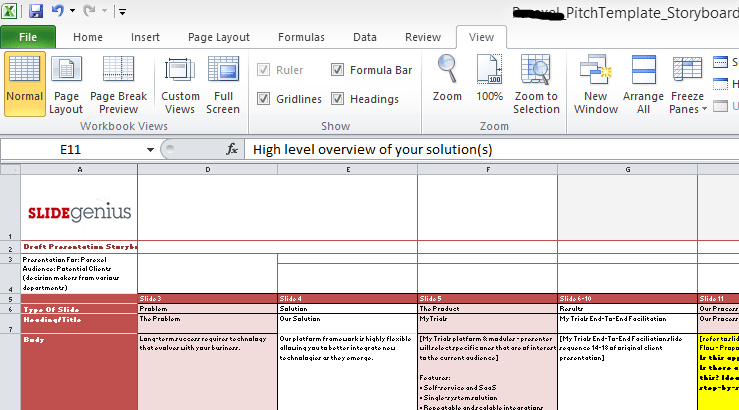
Want to try out a professional storyboard used by PitchDeck.com? Download our template here!

The wildly successful ’80s comedy Caddyshack is famous for it’s nearly nonexistent script. Supposedly, the script only contained twenty minutes worth of dialogue, and the rest of the movie was largely improvised.

Although it worked wonders for this film, against all odds, this strategy is surely a guarantee for disaster. A script not only gives a movie its direction and purpose, but it’s a huge organizational tool. It allows the movie’s writer and director to adequately prepare for filming and to visually map out all of the movie’s components.

SlideGenius uses storyboards to plot out and organize each of its professional presentations.
pitchdeck.com uses storyboards to plot out and organize each of its professional pitch decks.

Just as a script serves as a movie’s backbone, a “storyboard” is a vital tool for any professional pitch deck presentation, and it’s an essential part of the process here at pitchdeck.com. A storyboard is essentially a custom-tailored spreadsheet designed for planning out a presentation slide by slide, and it’s something we use for every pitch deck we create.

Storyboarding is the biggest step toward organizing your pitch deck, but there are several other important techniques useful before even opening up a pitch.

Your Topic

Condense the meaning or purpose of your speech down to a single sentence. If that task seems impossible, then it might be time to revise and trim the fat off your topic. After you put your pitch deck into its simplest form, make sure every slide you create contributes to this idea encapsulated in this sentence.

Pay Attention to Your Slide Headings

Do you have a lot of (Continued) slides? Do all of your headings appear to be similar or boasting about the merits of your business or product? This could be a sign that the pitch deck you’re creating could be more well rounded.

Cut the Word Count

After you’ve gone through and created your slides, go back and reduce as much as humanly possible. Question whether adjacent slides can be consolidated, or whether the information on the slides is made redundant by your talking points, rather than being complimentary.

Remember, an audience retains information from pitch deck much more effectively when slides have a small amount of information on them, and merely compliment what the speaker is saying. A cluttered pitch deck is often a sign of lack of planning.

After you’ve done this, go back through and once again, ask yourself, “Does each slide go along with the meaning of my pitch deck?” If you planned your pitch deck presentation correctly, this should be the easiest step.

References:

Caddyshack.Rottentomatoes.

“Study Shows Simplicity Is Key When Creating a PowerPoint Presentation.” SlideGenius. July 24, 2013.

How to Reduce Slide Text and Deliver a Great Pitch

One of the leading causes of Death by PowerPoint is information overload.

This can happen through putting excessive elements on your slide – from text to images, and even to font.

But it’s actually the inappropriate use of the program that leads to textual surplus. Too much text makes audience retain less information than a well-designed deck would.

Find out how to reduce slide text in pitch deck, and deliver a winning pitch with these three steps.

1. Move Away From Your Deck

Your pitch deck is primarily a visual aid, not a replacement for your presence.

Don’t copy-paste your content in the slides to fill in for what you can’t explain. Instead, step away from your deck and engage the audience. It’s necessary to make a personal connection with your listeners for you to seal the deal. Memorize the crucial points in your pitch deck, or even relate them to your personal experiences and share them as stories.

At the same time, you can also relate your core message through your actions as much as your words.

Project confidence through your body language and hand gestures, like sweeping your hand to discuss something, or clenching it to emphasize points. Establish eye contact as well to gain people’s trust.

Without overly relying on your pitch deck when you forget some of your points, pause to collect your thoughts. Be mentally focused on your pitch, and use your pitch deck only to supplement your words. Cut back on text and be more creative in expressing your ideas.

2. Replace Text with Images

Your content doesn’t need to stay as it is. Using pitch deck, transform your core message by rendering it from simple text or data to images.

With 65% of the population identifying as visual learners, according to professor Patricia Vakos of Pearson Prentice Hall, you’ll be able to communicate to a wider audience with content suited to them.

This doesn’t mean that you can place any picture that you want for each slide. Extra elements on the slide, like fancy borders and graphics, can be distracting to viewers.

If you’re presenting hard facts, use diagrams and charts to creatively and professionally visualize data. Choose images that will enhance your message, even if it’s inserting dollar bill icons to represent profits.

This both attracts the viewers gaze and contribute to your overall points.

3. Focus on Key Points

Text isn’t entirely banned from your slides. You can still use it, but not as a script to read from.

Reduce your words to key points that you can build up through your pitch. This is why it’s important to create an outline of your content before plugging into your deck.

An outline will help you determine the most important points of discussion for your topic. If these points come in a sentence, narrow it down to a phrase, or better yet, a word that will create a powerful impact on the audience.

People have limited attention spans, so giving them something creative, yet straight to the point helps drive home your message faster.

Plug in key points instead of paragraphs in your deck, and you’ll be sure to have your listeners’ attentions in no time.

Conclusion

Work together with your slides to deliver a great pitch. Use images instead of text when possible, but make sure the pictures you use are relevant to what you’re saying.

Break down data with visual representations like diagrams and charts.

If you’re still plugging in text, cut it down to key points that leave you enough room for explanation and audience engagement. That way, clients can remember your points better if they decide to call you after the pitch.

Need a pitch deck partner? Contact our pitchdeck.com experts today for a free quote!

References

Lesson 1 – Creating a Presentation Outline.” Thinkoutsidetheslide. Accessed December 23, 2015. www.thinkoutsidetheslide.com/lesson-1-creating-a-presentation-outline
Vakos, Patricia. “Why the Blank Stare? Strategies for Visual Learners.” Pearson. Accessed January 13, 2016. www.phschool.com/eteach/social_studies/2003_05/essay.html

Featured Image: “IMAG0021 Backspace” by Tom Anderson on flickr.com