
Slidegenius, Inc.

How to Turn a Business Plan into a Great Pitch Deck for Investors

It’s not always easy to raise capital for a new idea. Whether you’re just starting out or have been in the game for quite some time, you need significant preparation in order to make a favorable impression on potential investors.

You need time to research the validity of your idea, and to work out its details and technicalities. When you already have a comprehensive and viable business plan, the next step is to create a pitch deck that will make investors sit up and listen.

Are You Looking for a Pitch Deck?
View Our Amazing Pitch Deck Examples!

Most entrepreneurs make the mistake of including too much information in their investor pitch deck. They take their business plan, slap it into PowerPoint, and end up with a ridiculous amount of slides. Guy Kawasaki shared his experience of having to sit through pitches as a venture capitalist. He wrote,

…sixty slides about a “patent pending,” “first mover advantage,” “all we have to do is get 1% of the people in China to buy our product” startup. These pitches are so lousy that I’m losing my hearing, there’s a constant ringing in my ear, and every once in while the world starts spinning.

If you were in his place and you had to sit through a pitch that’s not only uninteresting but seems never-ending, wouldn’t you feel the same way?

We can’t allow investors to keep falling over due to vertigo, so here’s what you need to know about creating a powerful investor pitch deck:

What should a pitch deck contain?

pitch deck-target

A pitch isn’t about closing in on an investment just yet. Instead, think of it as an introduction. Just as you would with someone you just met, your pitch should serve as a conversation that will allow investors to learn more about your plans.

Your pitch deck doesn’t need to contain all the data from your research. According to Kawasaki’s own 10-20-30 rule of PowerPoint presentations and Chance Barnett‘s model for investor pitch decks, it shouldn’t have lengthy paragraphs or complicated graphs. All it needs are the things investors initially want to know:

  • Problem – Discuss the problem that you’re aiming to solve. Identify who is most affected by it.
  • Current solutions – Give a short rundown of how this problem is being solved currently. Point out what’s missing from these solutions.
  • Your solution – How do you plan to solve the problem? This is your chance to introduce your product/service and its story.
  • Underlying magic/technology – Go into your main selling point. What makes your product/service different? What’s the “secret sauce”? Include a demo if you can.
  • Business model – Discuss your key revenue streams. This is where you identify your target market and show off your numbers—pricing, revenues, conversion rates, etc.
  • Marketing and sales – Go into your marketing strategy. How do you plan to expand your customer base? What’s your targeted growth rate and how will you get there?
  • Competition – Where do you stand in the overall market space? Identify your competitors and explain how you’re different.
  • Team – Introduce the other people on the project with you and the key roles that they play. Show off their credentials and relevant experience.
  • Projections and milestones – Explain your financial projections, as well as your current milestones. Highlight some press mentions, partnerships, and other accolades.
  • Status and timeline – What is the timeline of your project and where are you at the moment?
  • Summary and call to action

These are the information that investors need to know to be able to tell if your plans are a perfect match for them.

Tips to keep in mind when working on your pitch deck:

pitch deck-work

  1. Cover only the most basic parts of your business plan and be as concise as possible. There will be time to go into specifics in the future. To keep it short, discuss only one concept per slide, and limit yourself to only 10.
  2. Let the investors dive into the minute details on their own. Give them separate documents like executive summary, patent details, financial and marketing reports, and other technical explanations. They can go through these documents after your pitch.
  3. The design of your pitch deck is important. Enhance your pitch deck with color schemes, images, and fonts that are consistent with the story you’re telling. We’ve written a lot about pitch deck design in the past. Read up on some of our blog posts if you’re looking to work on the aesthetics yourself. You can also drop us a line if you want a more professional touch.

Are You Looking for a Pitch Deck?
View Our Amazing Pitch Deck Examples!

.

Conclusion

An effective pitch deck doesn’t need to have every single detail of a business plan. Investors don’t have the time to sit through pitches that are too long and vague.

The point isn’t to immediately seal a deal, but to introduce your idea as something that has great potential for success. Your pitch deck should be clear and concise, showcasing only the key points of your vision. Be brief but memorable.

References

The 10/20/30 Rule of PowerPoint.” Guy Kawasaki. 2005. Accessed July 11, 2014.
Barnett, Chance. “The Ultimate Pitch Deck to Raise Money for Startups.” Forbes. May 9, 2014. Accessed July 11, 2014.

Featured Image: ImagineCup via Flickr
Icons: HauteSlides

Webinar PowerPoint Tips: Creating a Pitch Deck that Speaks through the Screen

In today’s world, distance is no longer an issue when it comes to effective communication. With web conferences or webinars, you no longer have to hop on a plane to sit in meetings with those in another time zone.

But there’s more to webinars than just talking in front of a webcam, especially if you want to share crucial information or leave a lasting impression. It’s important that you enhance your audience’s experience with a webinar pitch deck.

When you’re presenting in front a live audience, you’re physically available to command their attention. Your pitch deck slides serve a secondary purpose. However, when you’re presenting online, your webinar pitch deck is the main attraction.

With that in mind, consider these specific tips to make sure that your webinar pitch deck speaks through the computer screen.

Sequence: What your webinar pitch deck should contain

It’s important that your webinar pitch deck follows a structure with a logical flow. Begin with a quick introduction, delve in the main body of your topic, and end with a concise conclusion.

  • Introduction – Include slides introducing yourself and other presenters in the webinar. Include a picture and relevant credentials so your audience can feel like they’re not just talking to a computer screen. It’s also useful if you can include a slide that explains the logistics of your webinar.
  • Body – The body of your webinar pitch deck will depend on the topic you’re discussing. Whatever it is, keep your discussion clear but brief. Stick to discussing only one point at a time. There are plenty of ways to arrange the body of your webinar pitch deck, just make sure that each point is structured into main segments.
  • Conclusion – The conclusion of your webinar pitch deck should be short and sweet. Don’t drag it out by repeating everything you said before. Instead, create a slide that summarizes your main points. To encourage your audience to participate in a discussion, include an action plan or a call-to-action question.

Design: What your webinar pitch deck should look like

Your webinar pitch deck should be efficiently designed for online sharing. Lags on your pitch deck look unprofessional and can be frustrating for your audience.

Opt for a simpler, sleeker design. As always, avoid using too much text and bullet points. Most importantly, avoid using huge picture files, videos, and animations which might cause problems for connectivity. This doesn’t mean you should go completely without graphics. Just make sure the file sizes aren’t too large or are compressed before sharing. 

Consider the following when designing your webinar pitch deck:

  • When explaining something that requires several steps, consider making use of “build” slides. This is a type of animation that allows you to reveal a slide bit by bit as you talk.
  • Make use of PowerPoint’s SmartArt graphics to illustrate key points without having to use complicated images.
  • For your the background of your slides, opt for a solid color or gradient effect. Lower quality images might not be big enough to fill the entire background. And if you resize them, your background will look distorted and pixelated.

Reference

Reduce the File Size of a Picture.” Office Support. Accessed June 30, 2014.

Featured Image: Ministerio TIC Colombia via Flickr

How to Create an Investment Pitch Deck that Seals the Deal

Pitches are essential to raising capital for your company. A pitch deck presentation showcasing your core message helps you create a favorable impression. Forgo bombarding potential investors with endless bullet points and tables of data. Your investment pitch deck should be quick, unique, and engaging. Most importantly, it should reflect the story you’re trying to sell.
Consider these 4 tips when making an investment pitch deck:

1. Make a positive impression with the first slide

The title slide of your investment PowerPoint should convey the key message of your brand and presentation

When potential investors see your pitch deck flashed on the screen, the first slide should encourage them to say, “This looks interesting.”

The usual first slide contains only the following: company name, logo, and the presenter’s information. This isn’t enough to make a positive first impression. Aside from the given, the first slide should have visuals that reflect the main characteristics of  your brand. It should also include something that represents the main concept of your pitch deck.

2. Short and steady wins the race

The rest of your investment pitch deck should be brief and concise. Business guru Guy Kawasaki suggests that you limit your entire pitch deck to only 10 slides. While you shouldn’t take this as a hard-and-fast rule, it’s a great guide to keep in mind.

By limiting yourself to roughly 10 slides, you’ll be mindful to only include the most essential parts of your business plan. According to Kawasaki, these are the ten topics you should cover in your investment pitch deck:

  • Problem
  • Your solution
  • Business model
  • Underlying magic/technology
  • Marketing and sales
  • Competition
  • Team
  • Projections and milestones
  • Status and timeline
  • Summary and call to action

3. Show, don’t tell

Investment PowerPoint slides
Check out our portfolio to see these slides in action.

Utilize the technology available to you and incorporate multimedia elements to your investment pitch deck.

Use pictures, videos, or animations to demonstrate the idea you’re pitching. Your audience will find it engaging. They’ll be able to grasp your concepts better, becoming more likely to put their money behind it.

4. Be passionate and driven about your story

Potential investors won’t believe in what you’re presenting if you’re half-hearted about it yourself. There should be a powerful story at the heart of your investment pitch deck.

And this story is something that you should truly care about. As best-selling author Carmine Gallo said, passion is among the top factors that ultimately influences investment decisions.

Conclusion

Following these steps, your investment pitch deck will definitely give you leverage. But if you still feel unsure, you can consider consulting with us.

Our team of professional pitch deck experts will ensure that your slides are helping you put the best foot forward with a great pitch deck design.

References

Gallo, Carmine. “5 Must-Have Presentation Tips For Pitching To Angel Investors.” Forbes. Accessed June 19, 2014.
The 10/20/30 Rule of PowerPoint.” Guy Kawasaki. December 30, 2005. Accessed June 19, 2014.

Technology PowerPoint: Developing a Killer Pitch Deck for Your Video Game

Just like a traditional sales proposal, a video game pitch includes a summary that highlights a game’s selling points to a prospective publisher.

It details how profitable the game would be if ever the publisher agrees to develop or fund it. For an independent game developer pitching a game idea to an established publisher, a technology pitch deck can help communicate any concept more effectively.

Select the X Meets Y Formula

To grab your prospect’s attention, creating a very short version of your pitch would be a great idea. It gives you a way to set the stage for a longer concept pitch.

The best shortcut for this would be the formula:  X meets Y. For example, Warcraft is Dune II meets The Lord of the Rings. Got it? Another example: Max Payne, which is any John Woo film meets The Matrix. Mash-ups of well-known properties or genres may be a bit unimaginative, but it allows your audience to grasp your idea much faster.

If you can’t explain the concept quickly, your prospect might assume that your game isn’t ready yet for primetime and reject your proposal. A short pitch offers a great way for you to explain what your game is all about.

Level Up with Visuals

Technology pitch deck presentations work best when they feature graphics and imagery.

When pitching to gaming companies, we can’t stress enough how important visual aids are. Compared to the way it handles textual data, our brain processes graphic information way faster.

Additionally, people in the industry are visual thinkers and communicators. When you use visual aids, you are speaking their language and thus, giving your idea a chance to be assessed in a better light.

It would be great if you can come up with a professionally produced pre-production art to accompany your technology pitch deck slides. It creates the impression that you put so much thought into your proposal.

technology-powerpoint

Structure Your Proposal

While it is great to prepare a short pitch, it also pays to have a more detailed proposal handy. It should include all important details about your game.

The following are some of the information that you shouldn’t forget:

The High Concept – Pretty much like an elevator pitch, the high concept explains your idea as accurate as possible in a short sentence. Take note of the following gaming high concepts and learn:

  • Minecraft: Construct a 3D world with other players.
  • Unreal world: Survival game set in the Iron Age.
  • Super Mario: A platform game with a surreal world setting.
  • Sonic: A fast-paced platform game that features a fast hedgehog
  • Pacman: Navigate a maze while grabbing all the dots and avoiding bad guys.
  • Angry Birds: Slingshot birds at enemy pigs in this physics-based game.

Genre – The concept of genre in the gaming industry often has more to do with a game’s position in the shelves than its design or story. In general, a game’s genre is classified based on their type of gameplay.

Some of the most common video game genres are the following:

  • Adventure – Legend of Zelda, Tomb Raider
  • Strategy – Warcraft, Age of Empires
  • Role Playing Game (RPG) – Diablo, Final Fantasy
  • Shooter – Doom, Half-Life
  • Platformer – Super Mario Bros. Sonic the Hedgehog
  • Fighting – Street Fighter, Tekken

Other elements that you should include in your game technology pitch deck are the in-game story, setting, target audience, hardware platforms, marketing, and risk analysis. You should also tackle the gameplay description and features. If there’s still time, focus on the mechanics to show how players will interact with the game. You can start by describing the story to capture attention.

Then, shift your focus on what makes your gameplay different from other games of its kind.

Pitching a video game idea is not all fun and games. So be sure that you practice. A lot. For the win.

Designing a ‘How It Works’ Slide That Works

Do you find it difficult to explain to someone how a product, service, or process works? If your business involves selling new products or you’re constantly introducing new service features, then you’ll need an easy way to explain things. This is where the “How It Works” slides come in.

Explaining how certain things work is one of the most common uses of pitch deck slides. Done right, a “how it works” pitch deck can be effective for product demos, process flow illustrations, or pitching a business idea. To help you get started out, here are some ways you can make this type of slide work:

Lay it out

Pitch deck has several types of slide layouts. The default type comes with two boxes: The text box at the top, which is for the title of the slide, and the middle box, which is a multipurpose placeholder for text, graphics, or any content types.

For this purpose, however, you may choose the blank layout type and then simply insert the content that you need. Or better yet, as with the above slide, choose the Title Only template before putting all the other elements. To enhance the effect of your slide, feel free to choose from the Shapes and SmartArt Graphics.

Be consistent with colors

This one is pretty basic although there are still those who take it for granted. Buffer‘s Leonhard Widrich writes about how color schemes can affect our perception of a brand. The more recognizable colors have effectively been associated with specific brands, while those that were more difficult to point out didn’t have such a good color combination.

Similarly, pitch deck slides should have similar color schemes as they can affect the overall impact of your message.

Using varying combinations for different slides can confuse your audience. So for best results, make the color scheme of your How It Works slide consistent with the rest of your deck. This also applies to the slide itself. Looking at the above sample, you’ll notice that the color of the iVoteLIVE logo is consistent with that of the template. Apart from that, most of the imagery (i.e., photos and graphics) have similar shades of colors. This makes the slide pleasant to look at.

Take it easy with texts

This is another common concern and when it comes to How It Works slides, we can’t stress enough its importance. The purpose of slides is to describe visually something you can’t explain verbally. Why spend 15 minutes explaining a new feature, when a couple of images will take you just a few seconds, right?

If you’re going to include some texts, make sure not to mix up the fonts and font sizes just for the heck of it. Otherwise, your slide will appear visually confusing. Take a look at the sample again. While the format of the texts describing the consumers is different from the texts indicating the features (iVoteLive computer interface, Live Program Broadcasts), they still work because each group has specific purpose.

In short, they are not randomly mixed up.

The Takeaway: Engage with imagery

In general, images can make it easier for people to understand and remember ideas. So use relevant imagery instead of text in parts where you think a visual element would work better. When using images, though, be sure that they are of appropriate quality.

For scanned images, the ideal resolution is between 150 dpi (when precise color reproduction is not required) and 300 dpi (if you need higher quality images).

As much as possible, do not take images from the Internet as they usually of a very low quality and might pixelate when projected on a screen.

Reference

Widrich, Leonhard. “Why Is Facebook Blue? The Science of Colors in Marketing.” The Huffington Post. January 16, 2014. Accessed May 20, 2014.

Why We Are Different: Highlighting Your Competitive Edge

Today, most mainstream markets are becoming more saturated and difficult to penetrate, especially for budding entrepreneurs. This leads to companies and brands simply imitating each other in terms of features and benefits. But for those in these precarious market situations, customers have heard it all, and they’re not that impressed.

Defining your competitive edge can help establish your unique position in the market. With clearly defined benefits and features, your customers will know what really makes you a cut above the competitors and what steps you need to take to maintain that position.

pitchdeck.com Blog Module Three

Get hundreds of pitch deck slides for free.

Sign up for your free account today.

Sign Up now

Here’s how you can craft a slide stating your specific advantages:

Say it Fast

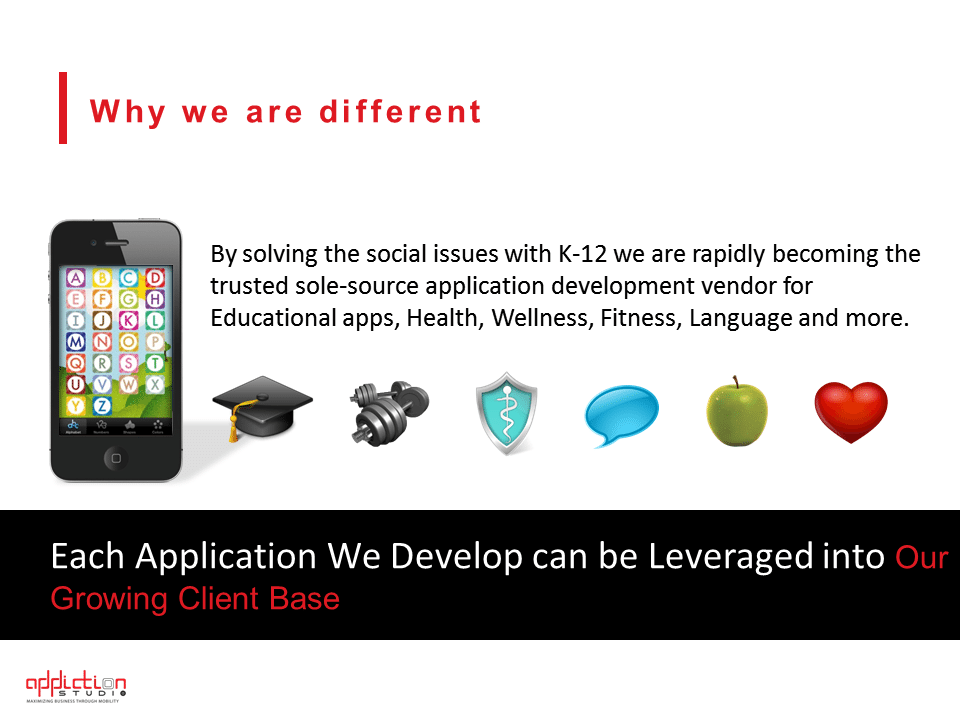
The “Why We Are Different” slide is a common fixture in corporate profile pitch decks.

Ironically, many organizations use the same strategy in describing the things that differentiate them from the crowd: They use bullet points. Enumerating your best qualities isn’t exactly the best way to present your competitive edge. If you can say it one sentence, the stronger your impact will be.

This doesn’t mean that you’ll be leaving out important details from your slide. It only means compressing the important points in one non-highfalutin and simple-to-understand sentence. Since we’re talking about customers who are tired of hearing the same things over and over, a brief but enlightening slide is a breath of fresh air for their tired gaze. Try to be as concise as possible in your slide. Don’t go off on tangent unless necessary.

why we are different

Back it Up

Another effective way to describe your edge over the competition is this: Don’t make it about the competition.

Make it client-driven. You can do this by identifying your customer base and describing the solution to their problem.

For most of your customers, you are the ideal provider not because of flashy advertising or due to popular choice, but because you are able to address their needs and challenges. In an interview with LoyalBlocks’ Ido Gaver, Kevin Daum enumerates the ways you can back up your statements and show your sincerity.

Show people that their loyalty to you has perks—whether it’s in terms of addressing them personally, or giving them perks like promos and freebies. Build and maintain your competitive edge on that opportunity.

Say it Loud

Now that you have an idea of what your competitive edge really is, it’s time to declare it to the world using your slide. You don’t need to use big, highfalutin words.

Simple words would be enough, as long as they sound sincere, not condescending and inappropriate. Use images to support your text. Make sure they are relevant and do not detract from what you want to say. An effective slide that aims to set you apart from the competition will only succeed if you bring together strategic techniques to the table.

pitchdeck.com Blog Module Two

Download free pitch deck templates now.

Get professionally designed pitch deck slides weekly.

Sign Up Now

Why We Are Different: Creating A Slide That Highlights Your Competitive Edge

Today, most mainstream markets are becoming more and more saturated and difficult to penetrate, especially for budding entrepreneurs. This leads to companies and brands simply imitating each other in terms of features and benefits. But for those in these precarious market situations, customers have heard it all, and they’re not that impressed.

Defining your competitive edge can help establish your unique position in the market. With clearly defined benefits and features, your customers will know what really makes you a cut above the competitors and what steps you need to take to maintain that position.

Here’s how you can craft a slide stating your specific advantages:

Say it Fast

The “Why We Are Different” slide is a common fixture in corporate profile pitch decks.

Ironically, many organizations use the same strategy in describing the things that differentiate them from the crowd: They use bullet points. Enumerating your best qualities isn’t exactly the best way to present your competitive edge. If you can say it one sentence, the stronger your impact will be.

This doesn’t mean that you’ll be leaving out important details from your slide. It only means compressing the important points in one non-highfaluting and simple-to-understand sentence. Since we’re talking about customers who are tired of hearing the same things over and over, a brief but enlightening slide is a breath of fresh air for their tired gaze. Try to be as concise as possible in your slide. Don’t go off on tangent unless necessary.

why we are different

Back it Up

Another effective way to describe your edge over the competition is this: Don’t make it about the competition.

Make it client-driven. You can do this by identifying your customer base and describing the solution to their problem.

For most of your customers, you are the ideal provider not because of flashy advertising or due to popular choice, but because you are able to address their needs and challenges. In an interview with LoyalBlocks’ Ido Gaver, Kevin Daum enumerates the ways you can back up your statements and show your sincerity.

Show people that their loyalty to you has perks — whether it’s in terms of addressing them personally, or giving them perks like promos and freebies. Build and maintain your competitive edge on that opportunity.

Say it Loud

Now that you have an idea of what your competitive edge really is, it’s time to declare it to the world using your slide. You don’t need to use big, highfalutin words.

Simple words would be enough, as long as they sound sincere, not condescending and inappropriate. Use images to support your text. Make sure they are relevant and do not detract from what you want to say. An effective slide that aims to set you apart from the competition will only succeed if you bring together strategic techniques to the table.

Reference

Daum, Kevin. “7 Great Ways to Build Customer Loyalty.” Inc.com. January 13, 2014. Accessed May 15, 2014.

Selling Your Wife with Pitch Deck: Why it Works

The universal question remains, “How do you win an argument with a woman?” 

Just like Phil and Claire Dunphy on ABC’S Emmy Award-winning show, Modern Familyit’s almost a daily struggle to prove who’s right and why. This timeless debacle has stumped husbands across the years as countless disagreements and failed persuasions have led to broken compromises.

We may believe that the common day pitch deck presentation is merely just for business lectures but the marketing and persuasive ability of pitch deck slides may actually be one of the best explanation tools. When dealing with certain difficult issues such as mapping out your financial plans for the year, a pitch deck presentation has the capability to share information in the most persuasive and simplest way possible; therefore allowing for more agreements- and fewer arguments.

1. Starting Off Your Pitch with an Attention Grabbing Quote

Just like in any persuasive essay or speech, the appeal of pathos (or emotion) when presenting your idea will catch your wife’s attention from the beginning. Your quote can also be a personalized statistic, say if you were trying to either sell or buy a substantial item or place that sums up a main purpose.

2. Utilize Visuals and Graphs

Images speak louder than words, too much text will cause anyone to lose interest fast. Using bar graphs and pie charts to explain your financial forecast or using graphics will make for any explanation to be easier and allow for more efficient points to be made. Talking numbers make for more confusion- but showing numbers allows for more information to be digested easily and this is essential in any great pitch deck presentation. 

3. Minimal Bullet Points

The simpler, the better. Bullet points are acceptable in family pitch decks and allow for direct and specific statements to be made without too much wordiness. You as the presenter are responsible for elaborating these ideas, but visually they should be presented in the simplest form.

4. Using If/Then Analogies

Creating an if/then scenario within your pitch will give you the ability to show your wife why your point is valid and using examples will assist in positioning your argument.


Convincing somebody of anything is not an easy task, and just like Phil and Claire try to make sure their points are the “correct” ones, you can utilize pitch deck to share your ideas with your spouse and explain them in the most effective way possible.

Comment below and let us know if you’ve used pitch deck to persuade your wife.

Raising Capital? Consider a Scrolling Web Pitch!

Raising capital is complicated. There are a lot of pieces to put together, including selling your audience, knowing your valuation, how much capital you need, use of funds and much, much more.

The initial hurdle for countless companies comes at the intersection where entrepreneurs and investors meet. Entrepreneurs often stumble building their investment deck and effectively pitching which makes it that much harder to get people to give you the capital. Investors must believe in you and your abilities to manage and grow a company. The problem is that showing who you are and what you’re capable of can be difficult let alone doing it in a 10-15 minute window.

For that reason you need to put your heart and soul into the pitch, but not just the content, also the delivery. What does a perfect pitch look like, you ask? That is a matter of opinion and you’ll never see the “perfect pitch deck”, but recently its all about presenting your company in a unique way to stand out from the crowd.  One additional option you may consider is a scrolling web pitch. Scrolling web pitches incorporate a unique scrolling technique that allow the presenter to replace the generic professional pitch deck click-by-click slides with an interactive, more organic and lively design.  This is not meant to be a replacement for the face to face pitch but a reinforcement and/or teaser to get the meeting.  Here are 4 reasons why you need to use scrolling web designs for you next investor pitch deck:

Keep Content Up to Date

In using a scrolling web pitch, you are making any future edits or updates to your text as easy as can be. This design simplifies the process and maximizes your use of time.

Stand Out from the Crowd and be unique

Most people email their large, boring and lifeless pitch deck presentations to prospective investors, but it really doesn’t make sense to do that. Without context from the entrepreneur you’ll risk a misinterpreted message or worse they might not even move past the first three slides.  Treat you pitch with respect. Why be dull and lifeless when you can be unique, creative and memorable?

Monitor page analytics/views and keep consistency

Data, data, data! Being able to keep your pitch up to date online and get analytics will help you assess the effectiveness of your deck. Additionally, you’ll have created another venue to market in. A great scroll web pitch will be able to sell itself without you being there, so any viewer could potentially bite in your concept.

Create more interest and leads

Analytics and views lead to increased interest and leads. Garnering and extrapolating public interest in your concept will serve as evidence to any potential investors as quality and a great opportunity.

Think of it as pitch deck presentation Darwinism: evolve your pitch or have it die. Though raising capital may be intimidating, challenging, and maybe seemingly impossible at times, the process starts with how you present yourself to people.

If you have any questions or comments about scroll pitches just comment them on this post?

An Angel Investor’s Guide to Cracking the Mind of an Angel Investor

“I would like to introduce myself to you. I am an angel investor. You may not have met the likes of me. I play several different roles. I am a listener to your presentations, a challenger of your strategy, an investigator conducting due diligence, a negotiator over investment terms, and finally a check writer to fund your growth.”


forumWho better to give advice for an angel investment pitch, than  an angel investor himself? Edward Harley, Angel Investor and member of the Keiretsu Forum, lays out exactly what you need to do to become part of the “top 5% of all presenters.” Though his context lies in the world of investor pitches, his advice is true and useful for anybody presenting about any subject.

Usually, you’ll have about 10 minutes to “pitch” your idea to an investor. Within those few minutes you need to successfully tell Harley’s seven stories:

1. The ‘fundamental business logic’ story

This is the part of your pitch deck that illustrates how you don’t just have an idea, but a logical approach to making a business out of it. Great ideas are valuable, but relatively useless without proper execution. Its great execution that changes the world. That is what investors, and really just audiences want understand from you; the steps you took or are taking to realize your idea. In other words, share your story.

2. The ‘total available market’ story

This section of your pitch deck is essentially the evidence you are using to support your “fundamental business logic story.” You are highlighting the path your business will walk on, and explaining how wide the passageway is.

3.’This is a $50m to $100m business’ story

Continuing on the “evidence” of your business logic story, this portion of the pitch deck is meant to display a sense of value. Your need to make your audience understand that your business venture is not only credible, but an enticing and convenient investment for them.

4. ‘The product can be differentiated’ story

Here, you’ll show why and how you are different and/or better than your competition. This is a key point. Your audience wants to know and identify your specialty. After all, it is that very specialty that people will remember you by. Harley says it that his  “expectation is that [he] will hear about a solution that is significantly better for the customer than all their existing choices, by ‘significantly better’, [he] mean[s] 10X better.”

5. ‘The product/service can be sold’ story

This area of your pitch deck should circle back to the past four sections. Here you should reaffirm that your product or service is reliable and has the potential to lead to satisfying results.

6. ‘This management team can do it’ story

You’ve made your case for the product or service, now you have to establish your credibility, and the credibility of your team, as a valuable, effective, and reliable workers.

7. ‘This is a good investment for the investor’ story

This portion of the pitch deck should sum everything up and reiterate the essential selling points. Here you are making the idea of an investment, sale, or whatever call-to-action concrete.

At the end of all this, it is time to ask yourself through the mentality of an investor, “Could I, your listener, replay to another person the very basics of your venture and how your target customers will benefit from using your product?”

If the answer to that is yes, then you have successfully boosted your chances to realize your pitch deck’s call-to-action.

Harley sums it up best by saying, “If you can passionately tell me those 7 stories while building a rapport with me where I eventually become an investor, we can jump over obstacles together. In addition to being a source of funds, I am a member of a terrific network of successful colleagues who are willing to assist you in your entrepreneurial effort. Our knowledge is both deep and wide, crossing industries, technologies, markets, and distribution channels. Thus, I encourage you to make the upfront effort to tell me your story. We can be successful together!”

Reference: